Every serious attempt to learn Solana ends up in the same place: solana-foundation/program-examples, the official repository of small, complete programs that the docs, the bootcamps, and half of Stack Exchange point at. It’s the right destination. It’s also code without a narrator: no reading order, no explanation of why a constraint exists, nobody telling you which lines are load-bearing and which are ceremony.
The obvious move is to reach for a book, and that’s where Solana surprises you. Rust developers got The Book. Solana developers got a self-published title from 2022 — written before Anchor’s biggest changes — some print-on-demand filler, and one chapter of a multi-chain Rust book. No major technical publisher has a Solana book at all. For a chain with this much running code, the shelf is close to empty.
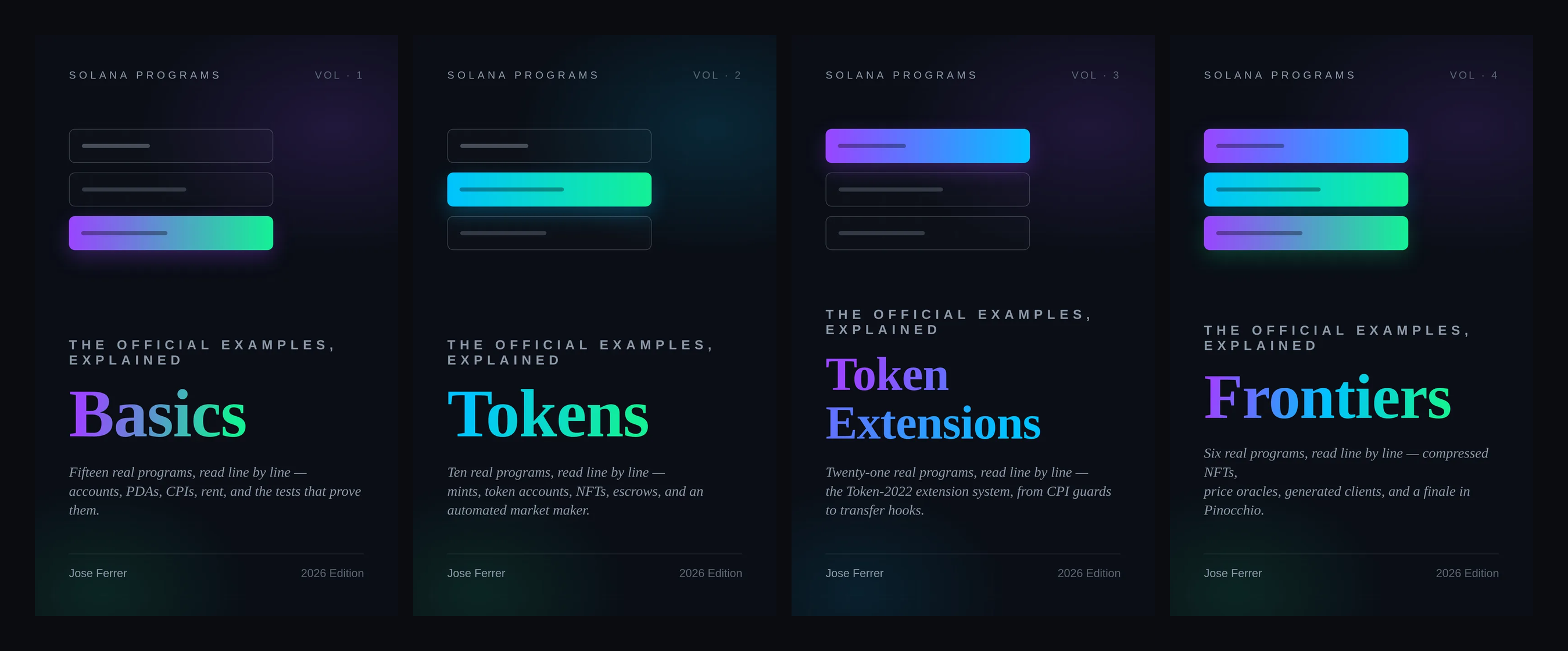
I got tired of waiting for someone else to fill it. Solana Programs is a four-volume series that walks the official examples line by line: fifty-two programs, from a first Anchor account to state compression, with the real source and the real test suites on the page. Volume one, Basics — accounts, PDAs, CPIs, and rent across fifteen programs, plus an appendix that writes the same Hello World in Anchor, native Rust, and Pinocchio so the framework becomes a choice — is out now for $9. The other three volumes (Tokens, Token Extensions, Frontiers) are written and getting the same review pass before they go on sale.
The rules I wrote them under
Three rules did most of the work, and they’re my answer to “why not just read the repository?”
- Everything quoted is real and pinned. Every excerpt comes verbatim from the repository at an exact commit, credited, with its license carried along. No pseudocode, nothing simplified-for-clarity, no line the compiler hasn’t seen.
- The whole program is on the page. A chapter never summarizes code and asks you to trust the summary. If a paragraph reasons about a constraint, the constraint is quoted above it. That makes the books readable where the repository isn’t: an e-reader, a plane, a sofa.
- Critical reading is part of the curriculum. A few of the official examples ship real bugs. The books don’t route around them — they flag them early, let you hunt, then dissect them at the end of the chapter. Reading a program skeptically is the skill Solana actually pays for.
Made with the tools I’d tell you to use
The series was written with heavy AI assistance — Claude, directed and reviewed by me, every program re-read from source at the pinned commit, every test quoted from the repository. The FAQ on the site says exactly that, because it should.
Two chapters are free
Two chapters also exist as free guides. No signup, no paywall:
- Program Derived Addresses, explained — the derivation, the bump, and why a client never has to ask where an account lives.
- Token-2022 and token extensions, explained — why Solana has a second token program, and what an extension physically is (TLV bytes on the mint itself).
More are coming; the hub is lamport.press/guides.
If you’ve followed the Anchor posts here — hello world through the Dutch auction — the books are the same philosophy applied to the official curriculum, starting earlier and going much further. And if the name rings a bell: the imprint is Lamport Press, because the lamport is Solana’s smallest unit, itself named for Leslie Lamport, who gave distributed systems their clocks and books LaTeX. A press at the intersection of both felt right.